
Software-Defined Voice Network (SDvN)
Control voice networks through software centralization
Software layer that decouples voice control from physical hardware, centralizing management across multi-site operations.
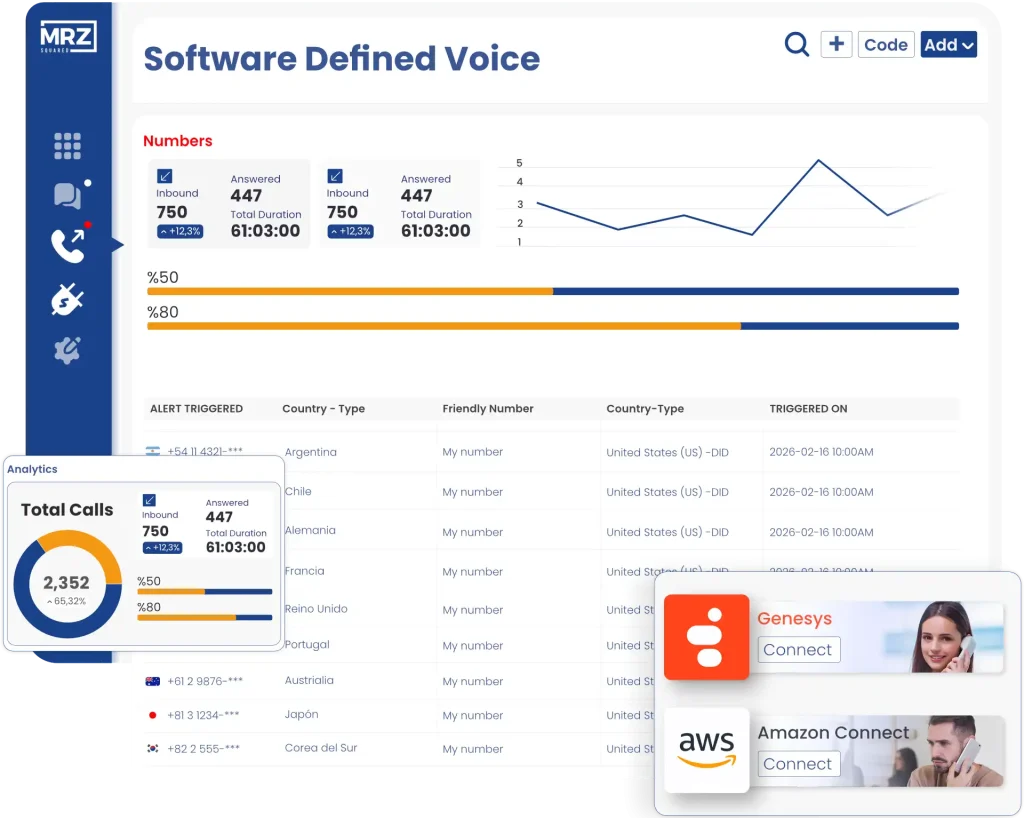
Traffic monitoring operates in blind spots
Traditional voice networks route through fragmented paths that bypass monitoring tools, exposing threats.
Rank uptime as primary carrier criterion
Hardware-bound control planes create single points of failure that threaten business continuity.
Platform silos block unified management
Disparate voice systems resist integration, forcing manual coordination across infrastructure.
A challenging context
Enterprise voice networks lack adaptive control
Legacy voice architectures bind control functions to hardware appliances, creating inflexible systems that cannot adapt to traffic surges, security threats, or infrastructure changes without manual intervention.
Why does Software-Defined voice Network (SDvN) matter now?
Voice infrastructure shifts to programmable models
Organizations face mounting pressure from hybrid work requirements, cybersecurity mandates, and cloud migration timelines that demand software-controlled voice networks capable of rapid reconfiguration.
5G deployment demands dynamic routing
Networks must handle 5.56 billion 5G subscriptions by 2030, requiring automated bandwidth allocation.
Security breaches target voice channels
VoIP systems face SQL injection, RCE vulnerabilities requiring Zero Trust architectures with real-time response.
Multi-Cloud strategies need abstraction
90% of businesses adopt hybrid cloud by 2027, requiring voice that operates across disparate environments.
Remote work mandates flexible capacity
Distributed teams require on-demand scaling without physical infrastructure changes at branch locations.
How it works
Five-phase deployment with continuous monitoring

Network assessment and architecture design
Map existing voice topology, identify hardware dependencies, and design software control plane migration path.
Software controller implementation
Deploy centralized management platform with API integrations to existing PBX, SBC, and carrier connections.
Policy configuration and testing
Establish routing rules, security policies, and failover protocols through phased testing across network segments.
Progressive migration and malidation
Transfer control functions from hardware to software layer while maintaining service continuity across sites.
24/7 Monitoring and optimization
Real-time network supervision with automated threat response and performance tuning based on traffic patterns.
Features
Complete visibility for continuity and risk control

Centralized policy enforcement
Single interface controls security, routing, and capacity across all voice endpoints, eliminating site-by-site changes.
Reduction in OpEx
Software control eliminates hardware refresh cycles and reduces maintenance contractor dependencies.
Real-time traffic engineering
Dynamic bandwidth allocation responds to call volume spikes within seconds, preventing congestion failures.
Faster change implementation
Configuration updates deploy across network in minutes versus days required for hardware-based modifications.
API-driven automation
Integrate with ITSM, security tools, and analytics platforms through RESTful APIs for workflow automation.
Sub-second failover capability
Software-defined paths reroute traffic automatically when primary routes fail, maintaining call quality.

Adapted to different scenarios
Does your voice infrastructure match these indicators?
Organizations operating contact centers, multi-site operations, or hybrid work models with legacy PBX systems constrained by manual provisioning and limited visibility represent optimal candidates for SDvN migration.
Multi-location operations with scaling needs
Companies with 10+ sites requiring frequent capacity adjustments or new branch connectivity deployments
Compliance requirements for call monitoring
Industries facing HIPAA, PCI DSS, or SOC 2 mandates requiring centralized audit trails and encryption enforcement
Aging infrastructure blocking cloud migration
Organizations planning UCaaS transitions but constrained by inflexible on-premise voice hardware investments
Why MRZ
The MRZ advantage in voice network transformation
MRZ combines carrier-grade infrastructure with software- defined control expertise, delivering voice networks that align with enterprise strategy through vendor-neutral architecture and performance- based service models.
Vendor-neutral architecture design
Engineer solutions across AudioCodes, Cisco, Microsoft, and Genesys platforms without proprietary lock-in.
Carrier-grade reliability standards
99.999% uptime SLAs backed by geo-redundant infrastructure and automated failover protocols tested quarterly.
Security-first implementation methodology
Zero Trust principles embedded in network design with end-to-end encryption and continuous vulnerability scanning.
24/7 NOC with voice specialization
Engineers certified in voice protocols monitor networks around-the-clock, resolving issues before user impact.
Achieve software-controlled voice infrastructure within 90 days
The SDN market reaches $39.1B in 2025 with 20.3% CAGR as enterprises abandon hardware-bound voice systems. Organizations delaying software-defined migration face mounting integration costs and competitive disadvantage.
